Wednesday, January 6, 2021

As the world burns

1/06/21

Acts of non-violent civil disobedience are honestly not the real problem.

Lies, misinformation, and perversion of the rule of law are the real problems.

Unfettered greed is a real problem.

Police violence and double standards are real problems.

I don't see a "riot" (but I don't claim to see everything that has happened today). I see people breaking laws, yes, but that never means they "deserve" to be shot. The police should be arresting them. Every single person who violated the barrier should be arrested and prosecuted--b/c the agreement you make in committing a non-violent act of civil disobedience is to accept the consequences.

But despite all the outrage, what I see is not the horrifying disaster the media reports. What I've seen is a (very misguided) protest, not an "insurrection." I don't see "mob violence." Had I seen guns raised, people shot--yeah, a different scenario.

We aren't bending to "mob rule." We recognize their right to protest, we arrest them when they go beyond protest into break laws . We step past them and get our work done. We let the rule of law guide the disposition.

But it is not enough to punish the misguided. We must find ways to make rule of law more resistant to the unfairness of inequities, less malleable to the influence of money.

Saturday, December 26, 2020

T&C

Thoughts around raising a happy family dog.


This is my preemptive response to all "new puppy at home" training questions, based exclusively on my own experience and--more importantly--mistakes as a dog owner; the things I'd wish I'd known and what people don't seem to say explicitly.  


Short-version: Training and conditioning are two different things. Training is simply making sure your pup knows what the command means. That's the easy part. Conditioning is REPEATED training until your dog responds without thinking every time you give the command. That takes--well, forever. Meaning that you will need to reward/reinforce your dog occasionally even after months and years of practice. Unless the behavior is self-rewarding. And rewards don't need to be food. 


Young puppies will bite and attack while you are teaching a better behavior--don't let that stop you. Redirect with a toy. Say no. Yelp. And keep doing it. You will start to see improvement after a few weeks. You won't extinguish the behavior for months. Pro tip: I wore an oven mitt for the first few weeks with my pup, as did my kids. You can begin to teach sit/down, whatever, as an alternate behavior, but the instinct to play like this won't be overcome for quite some time. Don't blame your pup. Train, redirect, condition. 


Start training and conditioning "Wait" at the door from day 1. As a safety measure, this one is essential. And you will feel dang good when your puppy listens b/c you are doing YOUR job keeping it safe. Google the training and do it off leash (use a pen outside the door if you are worried you'll be too slow to close the door quickly enough if the pup attempts to go out). 


Carry the pup out to potty (see below on leash training), and stay still and boring in the potty spot. I've waited 40 min almost motionless on a couple of WI winter nights to get a pup used to going outside, while the pup sniffed and attempted to engage me in a 6-foot radius around me. Ignore; don't engage. Don't go back in until something happens, then praise and reward. My rule was, potty on leaving create; potty break every 30 min of freedom and before going back to confinement, when pup was 8-16 weeks. The 30 min. stretched by 5-10 min every week w/out an accident. Set a time on your phone and confine or tether if you aren't 100% committed to honoring the schedule. Every single setback for me was when I gave us "a few more minutes." 


When your pup has done its business, do a few minutes of training it to follow you on a leash/leash training. Teach your pup to walk on a leash before you take it for walks, or you too will have dogs who pull. Everyone wants to walk their adorable 8 week old but that's a mistake. Google the training and find one that has your dog following you. You won't be able to take long walks for exercise for a while, so consider other options for play off leash--like a fenced yard, indoor, etc. (Here's a heads up: Long walks won't tire your Aussie, anyway.) So start with very short sessions after potty; you'll be doing a lot of potty breaks anyway, so 2-3 minutes of leash training after each break is fine. 


Use pens/crates/gate/tethering 100% of the time you are not ready to be actively engaged with your puppy. First and most importantly, a puppy needs to be SAFE and will find ways to be unsafe if left to its own devices. Stop feeling guilty. Google mental and physical exercise for your dog, and do your best. Contain your pup when you aren't "there" for it. And plan to do so for the next 1-2 years, depending on your tolerance for risk, mess, hair, and the unexpected. 


Don't count on your kids, not even teenagers, to be watchful. You got the dog; it's your job. Even if like me you were stupid enough to think your older kids would be more responsible this time around. It's on you--if you want it done right. And decide how important that is to you, b/c it's not worth fighting every battle with your kids OR yourself. 


A well-mannered house pet is relatively easy; a well-mannered dog that you can confidently travel with, hike with, shop with, etc., is more work.


And most important, please do not EVER blame your dog when it fails to obey. It's not stupid or willful; it's just not conditioned. If that is your expectation, it is on you to do the conditioning. 


Friday, March 20, 2020

Sinking into the couch and coronavirus

I've been social distancing since Friday, 3/13/2020. I had seen news about the novel coronavirus beginning in January, when students asked about it and we watched a video to discuss it. I'm not sure who might have thought, then, that this is the situation that would unfold. I didn't pay too much attention and wasn't too concerned until I saw the news that Harvard was going to online instruction only. That got my attention, as would the news from any major university. I started noticing how rapidly other institutions of higher learning were making similar decisions, and I realized the situation had become deadly serious.

I'm seeing postings about how we will all come together and this will bring about change in the US b/c we are learning the significance of everyday working people--truck drivers, delivery people, grocery store staff, health care workers (HCWs), teachers. I am shaking my head. I doubt anything will change, and too many Americans will continue to live paycheck-to-paycheck; too many companies will pay workers as little as they can get away with; our governments will continue to pour money into the "top" (corporate relief) despite the incredible amount of evidence that it doesn't trickle down to the rest of us.

Americans have short memories. I wonder if we could prove that those who left their homelands in the 1600s, 1700s, and 1800s, were statistically more likely to have ADD/ADHD or some other executive function deficit. Our inability to remember lessons learned is sometimes frightening. The historian in me wants an explanation. The special ed teacher in me just wants solutions. 

Saturday, May 3, 2014

The sad irony of "Right to Work" proponents

It might not be all that difficult, but I'm having trouble coming up with a political platitude that is more ridiculous and ironic than "Right to Work."

If we actually have a "right to work," then every company needs to hire everyone who applies. 

Whoa, whoa, whoa, I hear the simple-minded libertarian-types hollering. "Right to Work" applies only when unions are involved. It would be ridiculous to apply it to a free-market! Making every company hire whoever applies is the opposite of a free-market! 

Exactly. Which is why "right to work" is illogical in any sense. No one has a "right to work," except when that "right" is balanced by responsibilities--the responsibility to be qualified, to meet established criteria, etc, etc., etc. 

By shaving away one responsibility (to pay one's fair share of benefits received) while leaving intact the others, proponents of the so-called "right to work" open the door to shaving away ALL responsibilities--which, of course, is not what they intend, b/c doing so creates chaos in a free-market. If our "rights" are separated from responsibilities--as libertarians and tea-baggers and others of similar ilk like to do when it suits their notion of "rights,"--then purely consistent logical analysis means we can shave away those responsibilities in any context. 

Now, your teabaggers and their like-minded allies say this is a mis-application of logic, because they too recognize the concept of "responsibility," and they simply define it differently--as in, responsibility to one's self-interest. Except that saying one has a responsibility to one's self-interest is tautological--responsibility to one's self IS self-interest. This is redefining the concept of responsibility out of existence, which gets us back to the starting point: "right to work" has no corresponding responsibility, and therefore, cannot be considered a legitimate "right." 

We have to recognize that there are simply those people who--because of their own biological make-up-- have no sense of responsibility to others. They have attachments and sometimes a view of self-interest that leads them to behaviors that appear to demonstrate a sense of responsibility, but the sense of responsibility is simply not there. When these people behave in criminal ways, we label them sociopaths--but often, those with an atomistic sense of existence define criminal behavior as against their self-interest, and they live within the bounds of the law. But their thrust, their urge, their natural tendency, is always to put themselves first and make every decision based exclusively on how it will affect them.

Perhaps this appears to be a logical conclusion--after all, if I don't put myself first, who will? But the problem with this "logic" is that it denies reality--in particular, the reality that humans are as much social animals as we are individual specimens. Simplifying all decisions to one's self-interest, then, really is just that: simplifying, and simplistic. Sure, it is easier and more convenient and, of course, self-serving--what's not to love?

Reality, however, keeps getting in the way. Before we look at modern humans, let's step back and look at human animals--the primates in our evolutionary chain--and the other primates with whom we share a substantial portion of our DNA. Every single species in this chain is social: the existence of the individual depends on the existence of the group. At its most simple (for those who like simple explanations), this is illustrated in the mother-child relationship--the child cannot survive without the mother. When you stop to consider the number of species in which the offspring are not dependent on the mother--released into the wild at birth--the completely interdependent nature of human existence becomes obvious. 

Further, we can see that the mother--in addition to having been dependent on her own mother--is likewise dependent on the group. Survival of individual primates basically is so rare that it is clear no species would have survived, and none of us would be in existence had we not been social animals.

I'm summarizing an enormous amount of information here--but go ahead and try to prove me wrong. I don't need to cite the research, either, because although we have those who want to defend their adherence to self-interest, not even they would be so illogical or unrealistic as to claim we are not social animals. 

The next move of the self-interested would be to claim that it is only through a strict adherence to one's self-interest that the species was able to survive--but of course, this is not true, either. A strict adherence to one's self interest--if we go back to the mother-child pair--would mean abandoning one's infant. There is no logical or rational motive to parent an infant. Every moment spent tending to an infant's needs is a moment of self-interested action lost or deferred. 

Yet tending to infants is not simply a human trait--it is common among many species. So while we may have imbued this relationship with cultural significance, it is, at root, purely biological--natural, instinctual, inherent in our humaness. Nor is the instinct to care for infants purely female (in the sense of, tied to those with a preponderance of x-chromosome-related traits). Males of many species provide for infants, too. And while it is tempting to say that these actions stem from a desire to perpetuate our DNA, we must recognize that there is no intellectual involvement in that desire--it is, again, purely instinctual--a behavior "in the moment" that occurs without any reference to future gains. If it required anticipating the future to be activated, no other species would nurture their infants, b/c no other species can anticipate the future. The squirrel does not gather and store nuts in anticipation of the future-he does it because he is driven to that behavior, here and now. 

Males, furthermore, exhibit the social side of humaness when they bond with females.If sex were the sole drive at play, then non-consenual sex would be common in all primates, and especially in those with significant sexual dimorphism. Males could and would easily hold a female in place and satisfy their sexual drive, like a grown-up changing a todder's diaper. They would need neither permission nor violence. But this type of non-consensual sexual reproduction simply does not exist. The essence of sexual reproduction is pair-bonding--not exclusive, not permanent, but temporary and mutually beneficial pair-bonding. Certainly the practice proved highly successful in evolutionary terms, and those inclined to pair-bonding out-mated those individuals of a species who were not programmed to pair bond. But pair bonding serves no immediate biological purpose--again, it makes more sense (from an individualist perspective), for the male to abandon any connection to the female-and to come back (or seek out another female) the next time the urge strikes.But clearly, males who abandon females, who wandered off and then look around again only when the sexual urge returns, were not highly successful at surviving on their own, or we would have had a lot more of them--individuals highly successful in individual survival, mating enough to create a pre-historic and historical record of their abundance.  Devoting resources--food, energy, etc.--serves the species, not the individual. In this regard, then, pair-bonding is a manifestation of the social nature of humans. We need each other to survive.

Why am I bothering with all of this, you might ask? Why go over what many could just figure out on their own? Because, again, there are those among us whose "philosophy" denies the facts of human existence. Their reliance on "reason" and "logic" leads them to conclusions that are going to be utterly catastrophic for our species, and probably more immediately, for the future of the U.S. and perhaps other nations. 

Sunday, April 13, 2014

http://waitbutwhy.com/2013/09/why-generation-y-yuppies-are-unhappy.html

The self-absorption of any person is a matter of their individual experience; we cannot paint a whole generation with one stroke.

More importantly, this piece does not take into account the market collapses of the late 1980s and of course 2008. Depending on when the baby boomer parent was born and when "Lucy" was born, these two events have had a crushing effect on the lives of real people. Second, the policies in place during the post-war to 1980 were designed to promote the middle class. Those have been gone for 30 years now. So, things have really changed. Even if Lucy remains ambitious, chances are she won't end up where her parents did, and life IS harder for people when they aren't solidly middle class.

While I agree that people need to remain hard working and goal-oriented

Friday, October 4, 2013

A Conservative myth you really need to stop believing--and why

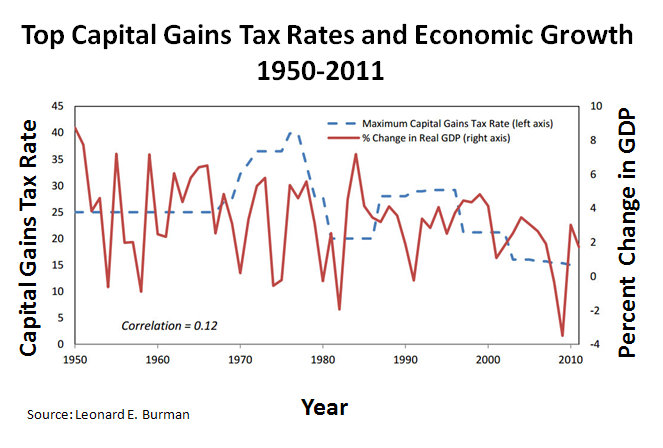
Conservatives argue that lower taxes for everyone--and, of course, esp. for big businesses--benefit all of us. It's called Trickle Down Economics, and the general argument says that when corporations make profits, they will invest those profits, create more jobs, hire more people, etc., etc. It sounds rational, but if you look at just 3 things, you will see that the historical evidence demonstrates just the opposite . From 1950 to the present, as capital gains and corporate tax rates declined, so too did the health of the American economy. The evidence is really pretty indisputable--and before anyone starts yelling, "but correlation isn't causation," you need to (a) carefully read the article published at http://www.slate.com/articles/health_and_science/science/2012/10/correlation_does_not_imply_causation_how_the_internet_fell_in_love_with_a_stats_class_clich_.html ; and (b) read the argument that follows the presentation of the evidence.

Between the two graphs, we see three things with a common trend line (that is, if you drew a line through each graph, the trend over time would be the same: a decrease from roughly 1970 to the present). So we can see that as capital gains taxes and effective corporate tax rates declined, so too did the state of the American economy. In fact, the conclusion of the author who created the first graph is that there is simply no evidence to support the assertion that low capital gains taxes correlate in any way to higher economic growth, nor do higher capital gains taxes correlate in any way to lower economic growth. What his evidence does show is that higher capital gains taxes correlate to higher economic growth, and lower capital gains taxes correlate to lower economic growth.

I'm not the first to notice or point out that Trickle Down Economics simply does not work. But too often, the argument gets bogged down into a lot of technical garbage, and the average person's eyes just gloat over. Really, we need to get back to the basics and accept that the simplest argument is usually right. In fact, anyone who has ever been in academics will know that after an initial argument/counter-argument (ok, maybe after a first round of rebuttal), the degree to which any additional tweaking of an argument or re-examination of evidence makes a difference is really, really minimal. It's fun and engaging to those trained in the language of the debate, but it is more-or-less meaningless in any real world sense. It is quibbling, to put it more bluntly. Until someone finally comes along to recast the discussion entirely, it really is just quibbling.

Let us return, then, to the two "Big Arguments" that frame American economic discussions: Trickle Down or Pump-Priming. As just demonstrated, we know that Trickle Down simply does not work: lower taxes on wealthy individuals and companies effectively depress the economy.

The real question, then, is, why? The answer lies in the behavior of wealthy individuals and corporations. To put it simply, they begin to hoard their profits. When the expectation of "safe" profits (meaning, safe from tax "losses") arises, companies use strategies that will limit the number of new employees needed by raising wages somewhat for existing workers while demanding ever more work from them ("work smarter, not harder"). They look for investment opportunities overseas, where they can get more for less--by exploiting foreign workers. They view the decrease in tax burden as a bonanza for themselves--executives, stock holders, surving employees--and hoard the profits for these groups. They have no interest in the commonweal, and they behave accordingly.

What conservatives do not tell you, then, is the ugly truth: that corporations and wealthy individuals will throw over the nation that puts its trust in them. They feel no loyalty to the country because they believe that they owe all their loyalty to themselves, to the company, to the stock holders. Under corporate law, it is actually illegal to "do the right thing," if that action would cut into profits--you can't go green unless it helps you make a buck, you can't "give back" unless it's going to make you more money in the long run. Furthermore, because the "corporate good" is defined by the bottom line on a quarterly basis, the short-term strategy trumps the long-term strategy almost every time. The idea of investing in America and Americans--because over the course of several years, that investment will pay off well--gives way to the plan to invest in China, because that plan will pay off tomorrow.

What is lost in all of this is the potential of the American economy--an economy that has proven extraordinary when it was primarily a consumer-driven economy (vs. a corporate profits economy, as it has become since the 1980s). What is lost is the distinction between "more workers" vs. "working more hours." When companies squeeze more work out of people, they increase their profits but decrease consumption by keeping a new worker out of a job. The net effect is that fewer things are needed/wanted, fewer things are purchased, fewer things need to be replaced by new items, and everything starts to slow down again.

The fact is, while self-interest drives a lot of things, it drives corporate policies in more and more myopic ways as the potential to retain profits increases. It is not unlike the way wealthier individuals may become more miserly as they become even wealthier. Perhaps this is a freak of nature. More likely, however, it is a learned behavior--one connected to another conservative myth, the primacy of the individual. When we take our nation's history out of its proper context--where the fight to protect individual rights was needed to balance out the lopsided emphasis on the common good (defined quite narrowly as the good of the State and those attached most closely to it)--we see an adoration of individualism, unfettered by the very real concerns for--and attention to--the common good, that characterized the world of our Founders. Self-interest, unleased, given no responsibility toward the Commonwealth that protects and promotes it, will and has betrayed that Commonwealth and proves undeserving of the freedom and opportunity it has been given.

So, what's a Country to do?

This is where "pump-priming" comes in--that is, fueling the conomy by redistributing wealth into more consumers' hands through tax policies. If companies will not share their wealth with the American people directly by paying better wages and hiring more people (and let's not forget that the only reason they are wealthy is because they are in America, where Americans do the work, and Americans buy the goods and services, and American tax dollars help pay for the infrastructure that allows business to go on), then they can do it indirectly--through the intervention of the government. There is simply nothing to replace the economic benefit of having well-paid Americans with suitable leisure time. We are a fun and generous people. When we have the time and money, we spend it on things we want and on those we love. We even invest some--saving for college and retirement, thus allowing companies to have or use our money too. Our individual wealth contributes to the national wealth--there is really no "downside" to having more people working, and more working in good paying jobs with reasonable hours.

Short-term self-interest is simply incompatible with long-term national interest. We need to restore the balance between the individual and the common good, and make every American citizen and every American company accept the responsibilities that have always--until modern times--been understood to co-exist with having rights. Only then will we be truly honoring the gift of freedom that our Founders endowed upon us, and only then will we begin to pay that gift forward to the generations that follow us.



Tuesday, March 26, 2013

The Sky hasn't fallen!

I'm just sitting here, shaking my head, wondering why people do not stop and think. The sky has NOT fallen, despite the claims of the GOP since at least the days of Reagan. The proudly-brandished lies of the great mis-leader (http://www.addictinginfo.org/2012/10/14/welfare-queen-myth-must-die/ gives a brief summary of the story of how Reagan created this particular myth) and the fears he flamed have proven . . . meaningless. Despite the decades of political sputum against the people who need the most help, despite warnings of national disintegration at the hands of feminists, minorities, "liberals," etc., we have had only one significant crisis, the Great Recession--and we all know who was responsible for that. As difficult as 9-11 was--and has been--on all Americans, it has had no where near the economic impact of the Mortgage Crisis.  (We could quibble about whether or not entering 2 wars at the same time--Afghanistan and Iraq--have a more significant impact b/c of what they have done to the national deficit, but let's not, at least not right now).

Reagan's policies, of course, led to the then-biggest crisis since the Great Depression, the economic collapse of 1987. Funny how no one seems to remember that. But then, we look at the Clinton years--and the balanced budgets of his 4 (I think; I'm too lazy to look it up again right now) final years. So then Obama inherits the Great Depression and all the deficit-expanding decisions of the Bush Administration, and people are again arguing that our tax dollars cannot support the sick, the young, the elderly, and the unemployed? I'm sorry to be crude, but where the fuck is the logic in that?

Sure, everyone--including the elderly--understands that social security can't continue at the current way it is designed; change will have to come, or we all have to agree to die younger. But that is a situation we can plan for, something most of us have some control over, if we fall (blessedly) into the middle class or above. How can anyone, however, justify taking tax dollars away from children, from their health or educational care? How can you talk about leaving people to watch their own children or parents die of treatable diseases because they are earning just enough not to qualify for healthcare?

Sunday, February 24, 2013

Flying and Guns: The Common Link

The fear of flying (and I'm talking about flying as in an airplane) is irrational. People who fear flying believe that because they are not in control, the situation is out of control. Facts do not tend to sway them--desensitization does. So despite the incredibly safe record of flying as a means of transportation and the much higher risk of being involved in an accident in your own car, people somehow continue to believe that as a driver, they are safer than flying in a plane. Most people also say they are good drivers while describing most other drivers as less reliable--something like 80% say they are good and will say only about 20% of others are good. Talk about a disconnect.

Gun owners are under a similar delusion, as far as I can tell. The information is quite clear: gun owners are more likely to be involved in crime and that crime is going to involve a gun; they--or someone in their household--are more likely to be injured by a gun (something like 42 times more likely, in fact) than those who do not keep guns.

So because of these irrational fears, the rest of us are forced to live in a society that is significantly more dangerous for all of us. The proliferation of guns makes it just too easy for the bad guys to have guns. We all know that and it would be silly to dispute because no one would need to fear being the victim of a gun-related crime if the criminals didn't have access to weapons. Thanks, gun lobby. Me, my children, and everyone I love is now more at risk because of you.

I am bitter about this, because I can see the paranoia in the postings on many sites of those who are scared enough to think that they need a gun to be safe--and who then also jump to the conclusion--despite all the evidence to the contrary--that owning a gun will make them safer. They cling to this irrational belief. Each one of them is convinced, individually, that THEY will be the exception to the rule. And all the while, the people of many other countries can live without fear of being accosted by an unanswerable weapon.

So let's address the mental health issues of gun fanatics. Talk about killing two birds with one stone--increasing mental health services and reducing gun proliferation. Yes, it will take time. Yes, the proliferation of guns and ammunition will mean that until guns are rare--a rifle or shotgun at home, in the event of an intruder, and everything else removed--we may see the paranoid a bit more paranoid. But as a society, it would be a small price to pay to get the guns out of the hands of the criminals, because future generations would be so much safer.

 And if only outlaws had guns, it would be a whole lot easier for the police to identify whom to arrest. Keeping your doors and windows locked, using safe habits in public--these are enough to keep those of us who don't walk around with guns safe. All the guns in the world won't protect you if you have unsafe habits, and you know that too. You don't need a gun: you just need common sense.


Sunday, February 17, 2013

Another take on gender issues


"[T]the only difference between you and I is that you think by making a man wait a "few weeks" that he will somehow be invested in a relationship."

"Most women say they know almost immediately whether or not they would sleep with someone and certainly by the first kiss. Let's assume that's true... you're in your mid 50's... you know you want to ... so why not?"

I’m not trying to attack the person who made those statements. I’m quoting him because I find these comments representative of misunderstandings and/or differences in thinking that seem to be clouding the waters in discussions about relationships between men and women of a certain age. (The French say that so much better).

Let’s take the first quote—and anyone who is a fan of Pride and Prejudice will understand where I am coming from. I do not know a single mature woman who would “hold back” because she wants to try to get the guy committed. That would be manipulative and unkind, frankly, not to mention risky (for the reason you say—men will just fake it to get what they want). Please note that I say “mature” woman, which means someone who has good self-esteem and feels confident about her ability to stand on her own two feet and does not make relationship decisions based on fear of her own inadequacy. People who are still responding to their own fears and insecurities are just not mature—and this is also not a criticism of them; it’s an observation. Maturity is the ability to think and decide rationally for one’s self, something that insecurity prevents in most young people and a fair number of older people. (My opinion based on observation, life experience, research, etc).

Now, so “why not,” then? Because actions have consequences, first and foremost. Having sex with someone based on attraction is not wrong, but it is higher risk. A rational assessment of that risk leads one to the understanding that STDs may be transmitted without any external evidence of their existence and in places not covered by condoms. A rational conclusion is that one should reduce one’s exposure to said risks.
Second, let’s consider the cost: benefit ratio from a different perspective (risk is in the “cost” column already, of course). What is the benefit of “why not?” In theory, it is a sexually satisfying experience. I’m guessing that most men would consider most sexual experiences satisfying enough if they experience orgasm, which they generally do. So from a male perspective, the cost: benefit analysis may appear rather even-some risk, almost certain benefit.

From a woman’s perspective, however, the cost: benefit ratio is quite different. From my personal experience and talking with other women (and I am open to more input on this-ha, no pun intended), the “benefit” of a sexually satisfying experience with a virtual stranger is by no means guaranteed. Many women can feel a very strong attraction to a man and also find the early sexual experiences quite unsatisfying. So the cost: benefit analysis has a very different outcome.

A mature woman making this calculation has learned, through her life experience, that most men need to be taught how to make love to her, what appeals to her, etc. The act of teaching a stranger about one’s body generally involves more emphasis on teaching than enjoying (yes, there are exceptions, but they are exceptions to the general rule), and one “lesson” is likely to involve more work than reward.

Bottom line: many women conclude that having sex with a stranger generally isn’t worth it. She needs to feel the attachment, the interest, to make it worth investing her time and energy. She’s not trying to “make” him feel attachment—that’s impossible. She is making choices for herself. Hell, for some of us, it isn’t even about needing to be “comfortable,” although for others, that is part of the equation too.

So, imagine you are the one who won’t be reaching orgasm or, in the course of getting there, will experience a lot of unpleasant sensations on some of your most sensitive body parts. Imagine that the person touching you is bigger and stronger and you do not really know anything about them, other than that they seem to be a lot of fun, seem to be stable, and you have a strong attraction to them. You are in a vulnerable position (just the two of you, but the other is stronger), you are taking a risk with your sexual health, some or much of the encounter won’t feel all that good, and chances are even you will either walk away frustrated or have to satisfy yourself in the end. That’s “why not.”

 We can satisfy ourselves without subjecting ourselves to the risk of STDs, weirdos, or unpleasant touches. If getting to know someone leads us to find they aren’t weird and they don’t have an STD I can catch, and we really like them, then we reach a point where we will take pleasure in their pleasure as we teach them, where the effort of teaching will be worth it (because we intend to see them again—we know we can’t determine if he will want to see us again).  From this perspective, I hope it is much easier to see why a lot of women think “Why would I have sex with a virtual stranger,” rather than “why not.”

Sunday, February 3, 2013

Paranoia: An "Aha!" Moment

I was reading some more "government conspiracy" posts on FB and got wondering about why there is so much hysteria out there about Obama planning to take over the government. Then I remembered the "PATRIOT" Act. Of course!

In the post 9-11 days and weeks where fear drove many people to behave uncharacteristically, including giving up many of their civil liberties, many supported the PATRIOT Act, which gave the Bush White House unprecedented access to our private thoughts and even words. Now Obama's White House has access to that same information.

I guess if I were an uneducated person, I might not have anticipated that the wide-open access I gave a conservative administration would quite likely transfer to a more liberal administration. 

A Simple Solution

In this contentious time of deep partisanship, I have a proposal that will solve many of our national woes. It requires some citizens to make small sacrifices of their civil liberties, but in the interest of national unity, such a sacrifice will be considered heroic. I guarantee that my proposal will address the problems most often mentioned by the right: the large and ever-growing number of lazy Americans and the continuing murder of innocent fetuses. I promise that my proposal will satisfy the concerns of the left, by making sure that every American in need has a sufficient and reliable safety net, in keeping with the standards of human dignity. So, if you are interested in real and specific proposals that will both reduce the number of lazy Americans and the number of abortions while preserving the dignity of each American, read on.

The objective of my solution is to make sure that every single child born in America has two deeply involved and committed parents who, between them, can earn enough money to supply the child's every need. At the same time, we must be careful to protect the fertility of American women, in the event that some unforeseen disaster might require higher birth rates than we have right now.

So, we must immediately plan to follow what I call the Couvade policy. To begin, we create a national database with the DNA of every male person--infant through adult--residing in the United States. This small sacrifice of civil liberty will, of course, not be felt as burdensome by American men once they understand the purpose. And that purpose is to make sure that each and every American man can father only one child in his lifetime. The reason for this is obvious: men who can only father one child will be deeply committed to that child, providing whatever it needs to guarantee that it, too, can reach adulthood, reproduce, and pass on the family genes.

Being the thoughtful and sympathetic nation we are, we will of course provide a bank where each man can provide a sperm donation to allow him to reproduce again in the event that his infant or child dies before it has the chance to pass on those genes. But as soon as a woman's pregnancy is confirmed, the Couvade policy would kick into high gear. A DNA sample of the fetal person would be taken by amniocentesis, and the paternity of the child confirmed by matching through the National Male Database (NMD). Once confirmed, the mother would know that the father would have an overriding interest in helping nurture and support the child, so she would have no reason to want an abortion. She could carry the child to term knowing that daddy will stay home with the baby when she does not want to; that daddy will provide the money for extras; that daddy will pass up the promotion which requires travel because he knows he needs to watch out for his child, so she might take such a job. The burdens of parenthood historically borne by women could now be divided between mon and dad!

But how, you might ask, can we guarantee that each man will take his fatherhood so seriously? This is where the simple beauty of the Couvade policy becomes clear. At the time paternity is confirmed, an expectant father will undergo the Couvade Procedure. Officers of the CPA (Couvade Policy Agency) will locate the expectant father and escort him to a Couvade Clinic (funded by private insurance, which of course all Americans will have because no father will want his one and only child to be without insurance!) At the clinic, a small, unobtrusive device known as the Couvade ring, will be placed around the top of the scrotum. Tempered from a metal alloy that activates the device into a tightening spiral, the Couvade ring will, over the course of 40 weeks, gradually shrink and compress the vas deferens, (the same organ severed if a man undergoes a vasectomy). This procedure, reportedly uncomfortable but not painful, reaches its climax in a period known as the travail. This period can last anywhere from several hours to a couple of days, during which the expectant father may need support. He arrives at the clinic when pain begins and might be encouraged to walk up and down the clinic hallways to facilitate the process by increasing his body heat, thus increasing the rate at which the Couvade shrinks. At the very last, the Couvade severs the connection between the scrotum and the body, effectively terminating ability of the patient to father any more children.

We can only imagine what a happy place the future will be, when every child has exclusive access to the man who is his father! Women, of course, must be allowed to retain their fertility for obvious reasons. For one thing, a man might wish to have a specific woman father his child, and since he is the one who only gets one chance (and assuming she agrees with him), he must be allowed to choose whatever woman he wishes. So women might have more than one child. Also, in the event of some unforeseeable crisis, such as a devastating epidemic, it will be the number of fertile women surviving which determines whether or not we can rebuild our population; a relatively few men could father children and sperm banks could be opened, but the women must be able to give birth, perhaps mulitple times!

Absent such a crisis, however, we would have a society in which every child has the financial support of a parent with no other children. Abortion would disappear. Women would have no incentive; the daunting reality that an unplanned pregnancy will completely limit a woman's choices will no longer exist; daddy will always be there to make sure little Johnny or little Janie is safe and well-cared for; he will drop everything to nurse the sick child, and will willingly accept the little darling in his home if mom wants to leave hers for a night of fun and adventure! Why, mom and dad might even be--or get--married, b/c daddy will know that his child's future depends on a happy mommy, too, and he will want to be around to ensure that mommy is happy!

The heavy tax burden of social services would likewise disappear,  and yet because of the parental commitment,each child will be raised with the dignity of sufficient resources to guarantee it becomes a productive member of society. Finally, "no child left behind" will be a reality, not a fantasy. All it takes is the willingness of a part of our society to make a small sacrifice, a sacrifice which pales in comparison to the rewards it will reap. Can there be any argument? No; no one could possibly object to losing the right to control what happens to one's own body when the results are so brilliant! Join with me, today, and demand "Couvade now!"


The Myth of the Free Market

You might think that by now, EVERYONE has figured out that there is pretty much zero direct connection between hard work and financial reward.

But the Ignorance Party--which calls itself "Tea" Party but is apparently ignorant of the actual meaning of the Boston Tea Party, hence the "new" name--continues to harp on and on and on how it is their high taxes, paying for the luxurious lifestyle of those who receive Federal support, that are their only impediment to greater financial success. According to their logic, if they didn't have to pay such high taxes for slackers, the whole economy would be so much better and they, themselves, would be climbing into the ranks of the well-to-do.

This argument, however, does not stand up to historical analysis. And any philosophical or logical analysis that ignores the evidence from history does so for purely political purposes--because such arguments cannot reference history for evidence.

First, though, let us put to rest the myth that it was the free-market system of early America that accounted for our astonishing economic growth from almost the day Europeans first settled here (those guys at Jamestown actually nearly ruined it, and were literally on a boat heading home when they were rescued, and a few years later, the discovery of a marketable corp--tobacco--saved the experimental colony). What truly accounted for America's fabulous wealth and growth was the fact that it could supply natural and renewable  resources to the world at exceptionally low cost because its forests and land were virtually untouched by previous human development. The yields of crops due to fertile soils and the tsunami of lumber, for example, had nothing to do with a free-market. The producers of Europe and Asia could not compete because their soils were worn out with millenia of production and harvesting. Cheap American products filled the breadbaskets of Europe, and the spread of resources and wealth was like the Biblical flood.

The abundance of the "new" continents was so vast that it not only produced fabulously fortunes for Americans, but also for the Europeans connected by trans-Atlantic trade. A quick survey of history finds that even in societies without free-markets, merchants could gain significant wealth through the limited trade available to them (and we must consider Asia and the Middle East in this analysis, not just Europe). The difference America made was that the resources were so vast that the number of people needed to facilitate the movement of these resources grew exponentially. Merchants needed more people to help them, and those people became wealthy. The availability of marketable goods now meant that even those "new" merchants needed more help--and so on, and so on. The "rising tide" that shaped America wasn't built on free-markets--it was built on the flood of goods that provided work for so many more hands. Economic systems designed to benefit the crown and elites did not go away--they also grew wealthier. But their wealth depended on taking full advantage of the opportunities available, and that meant encouraging the growth of the middle-class. No single political economy existed--diverse types co-existed. But all grew in wealth at a rate that seemed unprecedented in history.

The folks who did not grow wealthy during this bonanza were, largely, those doing most of the physical hard work. The enslaved in America, whose labor built the biggest and most persistent fortunes, those of the landed elite in the South, did not eat better or live better for their efforts. Of course, that's no proof of the failure of the free-market. So what about the American working class? How did they benefit from the "rising tide" of the free-market?

In two words: they didn't. The life and lifestyle of an American factory worker did not improve improve because of the free-market. It took labor union, Progressive-era reformers, and the New Deal to bring the working class up to middle-class living standards. Despite the enormous wealth America generated, the hardest working people failed to benefit until they and others stood up to the myth of the free-market.

These workers worked longer hours, in unpleasant and even treacherous conditions, than others. They went home to places that were equally unpleasant and treacherous. Their exposure to disease was not addressed for their sake; it was the risk their epidemics created for everyone that made efforts to improve sewers and other systems imperative.

What people miss in touting the free-market is that it was not the free-market that gave America its greatness. By raising wages for working-class people, this deviation from free-market thinking created vast numbers of new consumers. The demand that these new consumers made for more "stuff" drove the American economy so rapidly that we emerged from the crisis of World War I as a world power.

Of course, the business-minded leaders of the 1920s felt that the Progressives and unions had led the country from its true free-market path. They undid much of the legislation that preceded the growth of the 1890s, 1900s, and 1910s. Curiously, in the 1920s, the gap between rich and poor began to widen at a rate that hadn't been seen since before the Civil War. And, not surprisingly, as companies built stuff for consumers who no longer had the money to buy it, inventories rose. Factories slowed their production. Workers were laid off. Production slowed again. And, as we all know, the economy fell into the greatest Depression it had seen before or since.

It is, of course, ahistorical to assume that America might have weathered the world-wide Depression better had our leaders not made those changes in the 1920s. But it is hard to believe that, knowing the post-war condition of most of Europe, leaders would not have figured out that demand would drop. How and why they could not foresee the compounding effect of taking money out of the hands of American consumers is simply a mystery. Perhaps they, too, were blinded by a myth repeated so oft that they began to see it as fact. 

Saturday, December 29, 2012

"Just like anyone else": Why the T Party is really the I Party.

Latest Injustice Party line: the President and his family deserve no more protection than the rest of us.

Just like other people? Hmmmm, I haven't seen anyone else targeted by certain groups as a "traitor," accused of all sorts of crimes, and railed against by opposition like this since. . . ever. Yep, he and his family are no higher profile than anyone else. Just as Reagan wasn't. Or Kennedy. Or TR. Or Garfield. Or Mckinley. Not to mention Lincoln. Did I miss anyone?  Those were completely random acts that just happened to target a U.S. president, b/c they are just like everyone else.  The Obama family will need protection forever and probably more than most b/c of the hatred spewed by people who cannot seem to get their head around the fact that they live in a democracy and sometimes they will LOSE elections and therefore lose out on legislation and policies they'd prefer. These people do not understand that vituperative and unfounded accusations do not gain in credence just by being shouted over and over again, that failure to be able to understand that the President does not have the power to do more than 1/2 the things he's been accused of doing simply reveals their ignorance of the checks and balances within the Constitution.

I will no longer stand by and let ignorant people post their ignorance and injustice without contest. Yes, reasonable people recognize and ignore the ignorant--but what also happens is that the lack of response encourages the ignorant. I recognize that I'm fighting a losing battle--if my goal is to convince the ignorant of their own ignorance. It is not. It is simply to force them to shut up on whatever specific rant they are on--which they do. When they cannot respond to my logical contradiction of their position, they simply start a new line of attack. I've been experimenting since Sandy Hook, and it's a consistent response: when you cannot muster evidence to defend your position, abandon it and start something new.

Ignorance is not stupidity--Ignorance is curable. But it will remain to be seen if the I Party chooses to remedy its own ignorance.

OK, so from now on, I will refuse to recognize the miscarriage of history that the alleged "Tea Party" continues to perpetuate. The Boston Tea Party was about taxation without representation. I'm pretty sure every single member of the so-called Tea Party has the right to vote--and, therefore, has access to representation. It is an insult to our founders, to the men and women who stood up against the injustice of taxation without representation, to use that label for a group who suffers NONE of the injustice alleged. Who cares what they call themselves when the FACTS are against them? 

Monday, December 24, 2012

NRA strategy: Blame everyone else and ignore the Big White Elephant in the Middle of the Room.

I cannot believe that the NRA took the stance it has taken since Sandy Hook. It's like a gift to advocates of gun control.

One of the most common characteristics, apparently, of mass shooters, is their habit of blaming everyone else while accepting no responsibility for themselves. This, according to a leading expert on gun violence and mass shooters.

Had the NRA come out and admitted that perhaps its rigidity has, in fact, made it easy for children and other innocents to be fatal victims of gun violence, I might have thought there was hope for working with the NRA. But now, it has made it clear that "reason" is not within the NRA's own vocabulary.

Let's add to this the fact that I have taken the fight to FB where I have now heard rigid gun advocates saying there is a government conspiracy to overthrow the American civilian population, that the English people, press, and government are all liars, and that the issue is about crime, not guns (b/c being the victim of a crime without a gun is so much worse than being shot dead while being the victim of a crime committed by someone with a gun, I guess).

I am committed to researching everything I hear (and I'm good at it). I'm committed to listening to the arguments of those who oppose me and responding with reasonable, substantive arguments that are grounded in evidence. I'll continue to do this.

I have always resisted the characterization of gun lobbyists as "gun toting nuts." But the paranoia I have seen among acquaintances is beginning to make me wonder, as is their inability to be reasonable in the face of evidence with which they do not agree. When I am faced with evidence that contradicts my beliefs, my instinct is to question my beliefs--"Oh, wow, I didn't know that!" Then I take a step back and examine the evidence. Probably the most striking thing I've discovered is how quickly that evidence generally falls apart. I've found "facts" that were drawn selectively from source--where the rest of the facts contradicts what the selective evidence implies. I've found data from old sources that has clearly been addressed by other sources--and yet, that data has not been updated to address its own weaknesses.

I'm looking for someone on the other side to say, "Yes, but. . ." and then to articulate to me their assumptions. I do this all the time--I can concede a point without losing faith that my basic assumptions are still well founded.

I remember a student who used to ask me--when I told them that there was no "right" answer, "So we can just give our opinion, right?" I used to explain that even one's opinion should be grounded in evidence. It was important to me to get students to examine their own assumptions, to get past all the stuff those assumptions lead them to accept and to question the rational basis of the assumptions that they hold.

Here's what I want to know: do you really believe that the price of protecting American freedom is the current level of gun violence? Do you believe it is better that all our children and loved ones--not to mention ourselves--risk dying during a crime committed today, so that the government of this country cannot one day use our "defenselessness" against us?

If so, all I ask is that you examine those assumptions. How realistic is your assumption that an armed civilian population could overthrow a government committed against us? How realistic is your assumption that an unarmed civilian population cannot stand up against its government? Look at the world as it is today for your answers, b/c the evidence from the 18th century does you no good--the world is too different. Draw your conclusion, then explain to me how you arrived at your conclusion--and I will listen with an open mind. I am perfectly willing to be convinced that I am wrong--it's not an uncommon experience for me, after all. I'm perfectly willing to accept that I may arrive at the conclusion you have. But I need you to explain it to me in rational terms, to use evidence that is meaningful--or at the very least, to let me know where you have made a leap of faith. I can honor that, even if I do not agree with that. I can respect you for that, even if I will not defer to you because of it. I do not want to demonize my enemy because that always ends badly for everyone involved. Be my friend, and help me understand.


Thursday, December 20, 2012

We the People and the 2nd Amendment: Why we really are much better than this.

For the first time in recent memory, I am taking a stand and not backing down even though I'm scared.

I know many people who own and use guns responsibly. I know many people who own and use guns responsibly and also believe that we need much stricter gun control.

But I also know that among the many, many, many, many, many gun owners who consider themselves law-abiding citizens will be more than a few who decide that this "assault" on their 2nd Amendment rights constitutes an act of war. In their complete inability to understand that democracy is about NOT using violence to solve our deepest, most painful conflicts, some of these few will decide it is time to take action into their own hands. These are people who do not understand that living in a democracy ultimately means, giving up your own deepest beliefs when the majority is against you. It means letting go of slavery when the will of the nation decides it is wrong--letting go peacefully, because the exact thing you value most, if you are a true patriot, is the precious right of each of us to vote our conscience and the precious responsibility of each of us to abide by the outcome of that vote.

I suspect there are people in this country--maybe even in my neighborhood--who will see an argument like this and decide that their enemies need to be silenced. And this is what is scary.

I cannot be afraid any longer. The secret of a successful bully is to intimidate his or her victim into silence, to make them fear that retribution for standing up for themselves will be much worse than the assaults and threats they already suffer.

The gun lobby knows this. The people who defend their 2nd Amendment rights benefit from the implied threat of violence their access to  guns gives them. They do not have to say anything. They can be smug in their "superior" position. They can be silent, relying on the echo of grim jokes about prying guns from cold, dead hands.

But I am not powerless. I am empowered. I am empowered by the knowledge that the instant one of them uses a gun, and not a vote, to defend a position, that person has destroyed the illusion of their patriotism, of their commitment to the Constitution. And in that same moment, they have exposed their complete  misunderstanding of the power of that Amendment.

Because, in a democracy, We the People, ARE the government. Our collective will is the law of the land. If we, as a government, arrive at the decision that the 2nd Amendment has a different meaning than some ascribe to it, then this decision becomes the law of the land. If, through the democratic process, we arrive at the conclusion that assault weapons, semi-automatic weapons, and/or handguns, and the ammunition for such weapons, need to go, then there are only two choices: As an American, you submit to that decision even if you vow to continue to speak against it in the hope of one day overturning it. Or, if you cannot accept a democratically derived decision, you have the freedom to surrender your citizenship and find a place where your vision and understanding are shared.

What you do not have any right to do is to challenge, with arms, a decision of the American people arrived at through the democratic process. You do not have the right, in a democracy, to assert yourself with violence against the collective will. You cannot claim any higher moral ground, any "better" understanding, any "right" interpretation of our Constitution. It takes meaning only from what We the People ascribe to it. Our Constitution has been interpreted from the earliest days. We express our views through word and writing and the way we spend our money, and then we trust in the process. If we do not trust in the process--the process of government for, by, and of the People--we are betraying our Constitution.

In the age of Jefferson as well as the age of Lincoln, the majority of Americans understood this. They understood that you cannot choose to live in America and decline to honor the Constitution, decline to accept the Will of the People, however distasteful that Will may be to you. They understood you cannot claim one inch of American soil as yours while refusing to honor the Constitution.

Embedded in the 2nd Amendment is the premise that the vigilance of the people is essential to protecting our democracy. It is a premise acknowledged--no, embraced--by our founders. Our vigilance means an active participation in the democratic process. It means tolerating continuous dissent and accepting views radically different from our own and promising ourselves and one another that--above all--our differences will be resolved peacefully. This does not preclude anger and frustration and bitter arguments. It does not preclude the ugliness of uncivil debate (although I'd like to think we are better than that, too). It should preclude dishonesty and intentional obfuscation of the truth, but as that is dependent on the moral character of each individual, we can only hope for better than that.

What each of us must bring to the debate is, first and foremost, the willingness to accept that democracy involves responsibilities as well as rights. And there is more: democracy requires each of us to question the information provided to us, especially the information provided by like-minded people. It requires us to sift through the evidence to the best of our own ability, and to reach our own conclusions. It demands that we accept that others may have different goals from us. It expects each of us to find the courage to submit to what we cannot always understand. Democracy is simply an act of faith, submission to the Will of the People. If you can't live with that, you aren't much of an American to begin with.


Or, more likely

Tuesday, July 17, 2012

Time flies when you are having fun--but 4 years?

Well, there was The Divorce. I think it needs to be capitalized b/c divorce isn't just a process; it's a place you live--mentally--for a long while. The End of My Marriage (also requires capitalization; see "The Divorce") began in early 2009 and was finalized in early 2010. I initiated it, and I have no regrets. But it does take its toll, emotionally and financially. I'll probably get back to the topic at some point, but right now, it is kind of boring me right now (like my marriage did). Oh, and just for the record (because I have no intention of admitting this ever again), there is another side to the story. But it is wrong.

Some wet stuff is falling from the sky right now; not sure what it is. May a flock of geese flying over and urinating in unison (alliteration always allows an author advantageous authority). We have had such dry weather here that one of my sons says, "Climate change is really working for us, Mom!" Endless days of clear blue skies and warm (ok, hotter than heck temps. Sounds like an ideal opportunity to get outside and do something, right? Are you kidding? It's like having Patti the Personal Trainer glare at you 12 hours a day, mocking you for wanting to relax in side with a book, or blog, or some other form of mental entertainment. The sun glitters so brightly and all I want to do is draw the curtains and hide. "Let me be!" I cry. I like the outdoors, really, but in small doses that will not make me sweat so much that squirrels and other water-deprived species follow me around, lapping up the small stream trailing me.

But noooooo, Mother Nature (stupid bitch) has to create the perfect conditions for swimming! Tennis! Kickball! Hiking! Kayaking! Kavetching! Ok, I made up the last one, but seriously, just b/c it's nice outside, I don't have to live out there do I? I should point out that it is clear, warm, and BUG FREE, which is really the trifecta of perfect summer weather, so I don't even have the lame excuse of trying to avoid the mosquitoes. My cover is blown--Ms. Outdoorsy Girl (rhymes with Georgie Girl) likes her fresh air in small doses, preferably served between 72 and 76 degrees, humidity under 50%, indirect sun light, and mosquito free. That's not asking much, is it? Thank goodness my kids are out of town, because otherwise I have to pretend I'm all into healthy family routines and drag my sorry ass outdoors with them. My sorry ass is very comfortable in this Barca Lounger, thank you.

But you, you should stop reading this garbage and get out there. Really.

See you again--and I'll try to make sure it isn't another 4 years.

Sunday, June 15, 2008

Peter Panda Dance

Anyone who saw the movie The Pacifier with the Vin Diesel will recognize the title of this blog and probably wonder, "Why the hell would someone entitle a blog with that?" Frankly, I'm not sure, but a vision of Vin Diesel singing the song and a strong sense of the blues washed over me at the end of my last class. As the dress code "enforcer," I'm having some issues with female students who resent the interference. It's not MY dress code, but it is my job to speak to the girls who violate it--mostly because talking about low necklines makes the male faculty uncomfortable, and I'm the only straight female in the building most of the day. I understand all this, but the impact on my relationship with the female students saddens me. I work really hard to be fair to them and they cannot get beyond themselves on this--no surprise, they are teenagers, and that's all I can expect. So I need to keep reminding myself that while they make it "personal," it isn't really, because their reactions have nothing to do with me--they blame me because of who they are. And I love them dearly for who they are, myopic selfishness and all! The older I get (and I'm only 49, so I know I'm not THAT old), but more I appreciate the softness of youth's face, the plumpness in the cheeks and near the jawline that even the thinnest of them have, the lingering mark of baby fat that won't disappear until the bones of the face push through with the severity of adulthood, lines that harden with the weight and gravity of life's less pleasant surprises. I wouldn't want it any other way--given the alternative--but God do I love those young faces, whether 2 or 22! Will I always feel this way or does one reach a point where the silliness seems only like willful imbecility? Where naivite seems no different from stupidity? Is there any joy if that happens? Hard to imagine.

Saturday, June 14, 2008

It has a name!

"Trail running" to be exact. I have, apparently, always been a "trail running but didn't know it. And of course, like plain ol' "running," 99% of all the web space devoted to it is about racing and training for racing. Why can't it just be about the process, the running, not the time/finish/distance, etc? I just don't get why it is so competitive. Well, ok, I guess I do--it's easy to find out "who won" because all you need is a timer of some sort. But how do you measure joy or pleasure? You can't, so I guess we don't talk about that much here in America!

I intend to talk about that, however, as much as I can. Taking time to enjoy, to appreciate, whatever it is I am doing, means something to me. I suspect that is why I'm good at doing "nothing," because to me, that means I'm doing something: enjoying! Enjoying what, you might reasonably ask. Well--ok, get ready for this-I'm enjoying doing nothing! A paradox of the first rank, if you ask me.

Do you ever listen to the rhythm of your fingers as you type? I love doing this and sometimes I'm typing just to hear the rhythm. What I actually type is less important than the act of typing, the clippity-clip of my fingers and the way little black signs appear on the screen making whole words, ideas. Not everyone's cup of tea, but it adds to the pleasure of the moment for me. Like smelling coffee as I'm drinking it, and feeling the smoothness of the cup handle and the heat of the cup. Ummm. Cozy.

Little things like that add a lot to my enjoyment of daily life. If I waited for "the big things," it would be such a disappointing and tremendous waste of time. I see so many people rushing, rushing around. Driving is the worst. So many people are so aggressive, missing the pleasure of the act! From the feel of the wheel beneath my fingers, to the soft hum of the engine or the whistle of the wind (if the window is open), to the view of the sky and trees and life all around; blissful. Why rush? Why NOT enjoy? That does not mean I'm being inattentive; in fact, it's a heightened state of awareness--of my speed, of others around me, of road conditions--it comes with the territory--if one is paying attention, one notices such things. That's why I am so aware of the looks on the faces of people driving past me (not those screeching past because they have been trapped behind me! I drive a bit over the speed limit and stay in the right lane, ok?) I learned a long time ago that when I'm frustrated with other drivers, it means I'm tense, and if I can relax and make myself let go of those frustrations, it's as good as meditating; I'm at peace. Floating through space, even in a car, at 60 mph is a pretty neat thing that most human beings have NEVER experienced. It's worth noticing.

Just like running through a forest. Gosh, I wish everyone could enjoy that at some point, early in their life. We'd have a lot healthier population and a lot happier one, too. Once you "get it," you make time for it and you are repayed ten-fold, or a thousand-fold, for the effort! What do you do that makes you feel that way?

Sunday, May 25, 2008

It's Saturday night and I ain't got nobody . . .

Ok, so that is not true. I have a family-spouse, 3 kids-so I am almost NEVER alone. I've taken to hiking in the woods for my private time, something I was apparently really missing but didn't realize until one day, this winter, when I hiked with my kids as it snowed. The crispness of the air, the sharpness of the colors, everything reminded me how much I had loved the long, solitary jogs of my younger days. I would run 5, 6, 7 miles without feeling it, really, restricted only by time and the need to get other things done. I always felt I could have run forever and sometimes now wish I had, just to see what would have happened. Would I have gotten bored? I never did on the runs I took. Would I have gotten tired? Probably, eventually, maybe . . . I never pushed myself for speed, just enjoyed the rhythmic motion of my body, the feeling of power with each lift and step, each pump of an arm. Running felt like floating above where no one could touch me, where I was in a universe of my own making, immune to the weather, separated from man-made noise. Luck endowed me with a place for running unlike most will ever experience, at least in the US, a long, wood and field stretch of land that could not be developed because it lay on a river's flood zone, once pasturage or corn fields (and, one summer, a brief marijuana crop was there, although i never saw it). This Eden lay so quiet, waiting for nothing, needing nothing; it called me so often and although getting there and back meant running sometimes through enormous spider webs built across the trail-a trail only I ever used, for many years-it was always worth it. Even with the beautiful state park I now enjoy, I cannot recapture that silence-the absence of cars or other motors. It is never truly quiet for me, anymore, although I have moments of pure peace in the deepest part of the forest I now frequent.

Wow, this is so boring I don't even want to read it. But I was reawakened to my need for silence and solitude by that one moment of vision on a snowy day, and since then I have made the effort to indulge myself. I have had dream after dream about those old running days and maybe, with God's grace and a bit more o' Irish luck, I'll relive them yet.

Happy trails.

Saturday, May 10, 2008

Prom Night!

I will be chaperoning Prom for my high school students tonight, and I am looking forward to it! Seeing them all dressed up is such a treat. Yesterday, they had a "formal Friday," when they wore pretty nice clothes--past prom dresses or really nice dresses, suits for the boys, etc.--and that was fun. The girls will have their hair done up for tonight, makeup, etc., adding that extra touch.

Still, I'm so sad that my own son could not get past his shyness to ask someone to the dance. The pain of watching one's child be left out, always, always--I cannot describe it. Would it matter if the child was senseless of his own isolation? One student is physically handicapped but intellectually normal, and I imagine it is very hard on her family. No one can see my son's difference, and he gets labeled "lazy" and "weird," when in fact he is scared and lonely and often unable to absorb all that is said to him. But because he's bright (when he has information, he can use it so well) and strong and tall, no one has any clue, no sympathy--not my colleagues, his teachers, not his peers, whose ignorance I can more easily excuse because they are so young. I know he seems indifferent and we talk with him about body language--reading it, signaling it--but these are recent conversations, opened up only by his own desperation. God willing, he will make friends at college. I can only hope and pray; my heart sticks in my throat when I think how I will be unable to help him there.

How many other people share his loneliness? I am good at reaching out, but I vow to be better!