Friday, March 20, 2020

Sinking into the couch and coronavirus

I've been social distancing since Friday, 3/13/2020. I had seen news about the novel coronavirus beginning in January, when students asked about it and we watched a video to discuss it. I'm not sure who might have thought, then, that this is the situation that would unfold. I didn't pay too much attention and wasn't too concerned until I saw the news that Harvard was going to online instruction only. That got my attention, as would the news from any major university. I started noticing how rapidly other institutions of higher learning were making similar decisions, and I realized the situation had become deadly serious.

I'm seeing postings about how we will all come together and this will bring about change in the US b/c we are learning the significance of everyday working people--truck drivers, delivery people, grocery store staff, health care workers (HCWs), teachers. I am shaking my head. I doubt anything will change, and too many Americans will continue to live paycheck-to-paycheck; too many companies will pay workers as little as they can get away with; our governments will continue to pour money into the "top" (corporate relief) despite the incredible amount of evidence that it doesn't trickle down to the rest of us.

Americans have short memories. I wonder if we could prove that those who left their homelands in the 1600s, 1700s, and 1800s, were statistically more likely to have ADD/ADHD or some other executive function deficit. Our inability to remember lessons learned is sometimes frightening. The historian in me wants an explanation. The special ed teacher in me just wants solutions. 

Saturday, May 3, 2014

The sad irony of "Right to Work" proponents

It might not be all that difficult, but I'm having trouble coming up with a political platitude that is more ridiculous and ironic than "Right to Work."

If we actually have a "right to work," then every company needs to hire everyone who applies. 

Whoa, whoa, whoa, I hear the simple-minded libertarian-types hollering. "Right to Work" applies only when unions are involved. It would be ridiculous to apply it to a free-market! Making every company hire whoever applies is the opposite of a free-market! 

Exactly. Which is why "right to work" is illogical in any sense. No one has a "right to work," except when that "right" is balanced by responsibilities--the responsibility to be qualified, to meet established criteria, etc, etc., etc. 

By shaving away one responsibility (to pay one's fair share of benefits received) while leaving intact the others, proponents of the so-called "right to work" open the door to shaving away ALL responsibilities--which, of course, is not what they intend, b/c doing so creates chaos in a free-market. If our "rights" are separated from responsibilities--as libertarians and tea-baggers and others of similar ilk like to do when it suits their notion of "rights,"--then purely consistent logical analysis means we can shave away those responsibilities in any context. 

Now, your teabaggers and their like-minded allies say this is a mis-application of logic, because they too recognize the concept of "responsibility," and they simply define it differently--as in, responsibility to one's self-interest. Except that saying one has a responsibility to one's self-interest is tautological--responsibility to one's self IS self-interest. This is redefining the concept of responsibility out of existence, which gets us back to the starting point: "right to work" has no corresponding responsibility, and therefore, cannot be considered a legitimate "right." 

We have to recognize that there are simply those people who--because of their own biological make-up-- have no sense of responsibility to others. They have attachments and sometimes a view of self-interest that leads them to behaviors that appear to demonstrate a sense of responsibility, but the sense of responsibility is simply not there. When these people behave in criminal ways, we label them sociopaths--but often, those with an atomistic sense of existence define criminal behavior as against their self-interest, and they live within the bounds of the law. But their thrust, their urge, their natural tendency, is always to put themselves first and make every decision based exclusively on how it will affect them.

Perhaps this appears to be a logical conclusion--after all, if I don't put myself first, who will? But the problem with this "logic" is that it denies reality--in particular, the reality that humans are as much social animals as we are individual specimens. Simplifying all decisions to one's self-interest, then, really is just that: simplifying, and simplistic. Sure, it is easier and more convenient and, of course, self-serving--what's not to love?

Reality, however, keeps getting in the way. Before we look at modern humans, let's step back and look at human animals--the primates in our evolutionary chain--and the other primates with whom we share a substantial portion of our DNA. Every single species in this chain is social: the existence of the individual depends on the existence of the group. At its most simple (for those who like simple explanations), this is illustrated in the mother-child relationship--the child cannot survive without the mother. When you stop to consider the number of species in which the offspring are not dependent on the mother--released into the wild at birth--the completely interdependent nature of human existence becomes obvious. 

Further, we can see that the mother--in addition to having been dependent on her own mother--is likewise dependent on the group. Survival of individual primates basically is so rare that it is clear no species would have survived, and none of us would be in existence had we not been social animals.

I'm summarizing an enormous amount of information here--but go ahead and try to prove me wrong. I don't need to cite the research, either, because although we have those who want to defend their adherence to self-interest, not even they would be so illogical or unrealistic as to claim we are not social animals. 

The next move of the self-interested would be to claim that it is only through a strict adherence to one's self-interest that the species was able to survive--but of course, this is not true, either. A strict adherence to one's self interest--if we go back to the mother-child pair--would mean abandoning one's infant. There is no logical or rational motive to parent an infant. Every moment spent tending to an infant's needs is a moment of self-interested action lost or deferred. 

Yet tending to infants is not simply a human trait--it is common among many species. So while we may have imbued this relationship with cultural significance, it is, at root, purely biological--natural, instinctual, inherent in our humaness. Nor is the instinct to care for infants purely female (in the sense of, tied to those with a preponderance of x-chromosome-related traits). Males of many species provide for infants, too. And while it is tempting to say that these actions stem from a desire to perpetuate our DNA, we must recognize that there is no intellectual involvement in that desire--it is, again, purely instinctual--a behavior "in the moment" that occurs without any reference to future gains. If it required anticipating the future to be activated, no other species would nurture their infants, b/c no other species can anticipate the future. The squirrel does not gather and store nuts in anticipation of the future-he does it because he is driven to that behavior, here and now. 

Males, furthermore, exhibit the social side of humaness when they bond with females.If sex were the sole drive at play, then non-consenual sex would be common in all primates, and especially in those with significant sexual dimorphism. Males could and would easily hold a female in place and satisfy their sexual drive, like a grown-up changing a todder's diaper. They would need neither permission nor violence. But this type of non-consensual sexual reproduction simply does not exist. The essence of sexual reproduction is pair-bonding--not exclusive, not permanent, but temporary and mutually beneficial pair-bonding. Certainly the practice proved highly successful in evolutionary terms, and those inclined to pair-bonding out-mated those individuals of a species who were not programmed to pair bond. But pair bonding serves no immediate biological purpose--again, it makes more sense (from an individualist perspective), for the male to abandon any connection to the female-and to come back (or seek out another female) the next time the urge strikes.But clearly, males who abandon females, who wandered off and then look around again only when the sexual urge returns, were not highly successful at surviving on their own, or we would have had a lot more of them--individuals highly successful in individual survival, mating enough to create a pre-historic and historical record of their abundance.  Devoting resources--food, energy, etc.--serves the species, not the individual. In this regard, then, pair-bonding is a manifestation of the social nature of humans. We need each other to survive.

Why am I bothering with all of this, you might ask? Why go over what many could just figure out on their own? Because, again, there are those among us whose "philosophy" denies the facts of human existence. Their reliance on "reason" and "logic" leads them to conclusions that are going to be utterly catastrophic for our species, and probably more immediately, for the future of the U.S. and perhaps other nations. 

Sunday, April 13, 2014

http://waitbutwhy.com/2013/09/why-generation-y-yuppies-are-unhappy.html

The self-absorption of any person is a matter of their individual experience; we cannot paint a whole generation with one stroke.

More importantly, this piece does not take into account the market collapses of the late 1980s and of course 2008. Depending on when the baby boomer parent was born and when "Lucy" was born, these two events have had a crushing effect on the lives of real people. Second, the policies in place during the post-war to 1980 were designed to promote the middle class. Those have been gone for 30 years now. So, things have really changed. Even if Lucy remains ambitious, chances are she won't end up where her parents did, and life IS harder for people when they aren't solidly middle class.

While I agree that people need to remain hard working and goal-oriented

Friday, October 4, 2013

A Conservative myth you really need to stop believing--and why

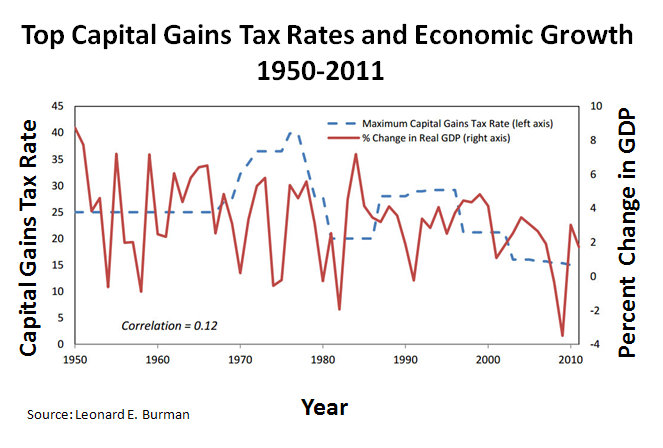
Conservatives argue that lower taxes for everyone--and, of course, esp. for big businesses--benefit all of us. It's called Trickle Down Economics, and the general argument says that when corporations make profits, they will invest those profits, create more jobs, hire more people, etc., etc. It sounds rational, but if you look at just 3 things, you will see that the historical evidence demonstrates just the opposite . From 1950 to the present, as capital gains and corporate tax rates declined, so too did the health of the American economy. The evidence is really pretty indisputable--and before anyone starts yelling, "but correlation isn't causation," you need to (a) carefully read the article published at http://www.slate.com/articles/health_and_science/science/2012/10/correlation_does_not_imply_causation_how_the_internet_fell_in_love_with_a_stats_class_clich_.html ; and (b) read the argument that follows the presentation of the evidence.

Between the two graphs, we see three things with a common trend line (that is, if you drew a line through each graph, the trend over time would be the same: a decrease from roughly 1970 to the present). So we can see that as capital gains taxes and effective corporate tax rates declined, so too did the state of the American economy. In fact, the conclusion of the author who created the first graph is that there is simply no evidence to support the assertion that low capital gains taxes correlate in any way to higher economic growth, nor do higher capital gains taxes correlate in any way to lower economic growth. What his evidence does show is that higher capital gains taxes correlate to higher economic growth, and lower capital gains taxes correlate to lower economic growth.

I'm not the first to notice or point out that Trickle Down Economics simply does not work. But too often, the argument gets bogged down into a lot of technical garbage, and the average person's eyes just gloat over. Really, we need to get back to the basics and accept that the simplest argument is usually right. In fact, anyone who has ever been in academics will know that after an initial argument/counter-argument (ok, maybe after a first round of rebuttal), the degree to which any additional tweaking of an argument or re-examination of evidence makes a difference is really, really minimal. It's fun and engaging to those trained in the language of the debate, but it is more-or-less meaningless in any real world sense. It is quibbling, to put it more bluntly. Until someone finally comes along to recast the discussion entirely, it really is just quibbling.

Let us return, then, to the two "Big Arguments" that frame American economic discussions: Trickle Down or Pump-Priming. As just demonstrated, we know that Trickle Down simply does not work: lower taxes on wealthy individuals and companies effectively depress the economy.

The real question, then, is, why? The answer lies in the behavior of wealthy individuals and corporations. To put it simply, they begin to hoard their profits. When the expectation of "safe" profits (meaning, safe from tax "losses") arises, companies use strategies that will limit the number of new employees needed by raising wages somewhat for existing workers while demanding ever more work from them ("work smarter, not harder"). They look for investment opportunities overseas, where they can get more for less--by exploiting foreign workers. They view the decrease in tax burden as a bonanza for themselves--executives, stock holders, surving employees--and hoard the profits for these groups. They have no interest in the commonweal, and they behave accordingly.

What conservatives do not tell you, then, is the ugly truth: that corporations and wealthy individuals will throw over the nation that puts its trust in them. They feel no loyalty to the country because they believe that they owe all their loyalty to themselves, to the company, to the stock holders. Under corporate law, it is actually illegal to "do the right thing," if that action would cut into profits--you can't go green unless it helps you make a buck, you can't "give back" unless it's going to make you more money in the long run. Furthermore, because the "corporate good" is defined by the bottom line on a quarterly basis, the short-term strategy trumps the long-term strategy almost every time. The idea of investing in America and Americans--because over the course of several years, that investment will pay off well--gives way to the plan to invest in China, because that plan will pay off tomorrow.

What is lost in all of this is the potential of the American economy--an economy that has proven extraordinary when it was primarily a consumer-driven economy (vs. a corporate profits economy, as it has become since the 1980s). What is lost is the distinction between "more workers" vs. "working more hours." When companies squeeze more work out of people, they increase their profits but decrease consumption by keeping a new worker out of a job. The net effect is that fewer things are needed/wanted, fewer things are purchased, fewer things need to be replaced by new items, and everything starts to slow down again.

The fact is, while self-interest drives a lot of things, it drives corporate policies in more and more myopic ways as the potential to retain profits increases. It is not unlike the way wealthier individuals may become more miserly as they become even wealthier. Perhaps this is a freak of nature. More likely, however, it is a learned behavior--one connected to another conservative myth, the primacy of the individual. When we take our nation's history out of its proper context--where the fight to protect individual rights was needed to balance out the lopsided emphasis on the common good (defined quite narrowly as the good of the State and those attached most closely to it)--we see an adoration of individualism, unfettered by the very real concerns for--and attention to--the common good, that characterized the world of our Founders. Self-interest, unleased, given no responsibility toward the Commonwealth that protects and promotes it, will and has betrayed that Commonwealth and proves undeserving of the freedom and opportunity it has been given.

So, what's a Country to do?

This is where "pump-priming" comes in--that is, fueling the conomy by redistributing wealth into more consumers' hands through tax policies. If companies will not share their wealth with the American people directly by paying better wages and hiring more people (and let's not forget that the only reason they are wealthy is because they are in America, where Americans do the work, and Americans buy the goods and services, and American tax dollars help pay for the infrastructure that allows business to go on), then they can do it indirectly--through the intervention of the government. There is simply nothing to replace the economic benefit of having well-paid Americans with suitable leisure time. We are a fun and generous people. When we have the time and money, we spend it on things we want and on those we love. We even invest some--saving for college and retirement, thus allowing companies to have or use our money too. Our individual wealth contributes to the national wealth--there is really no "downside" to having more people working, and more working in good paying jobs with reasonable hours.

Short-term self-interest is simply incompatible with long-term national interest. We need to restore the balance between the individual and the common good, and make every American citizen and every American company accept the responsibilities that have always--until modern times--been understood to co-exist with having rights. Only then will we be truly honoring the gift of freedom that our Founders endowed upon us, and only then will we begin to pay that gift forward to the generations that follow us.



Tuesday, March 26, 2013

The Sky hasn't fallen!

I'm just sitting here, shaking my head, wondering why people do not stop and think. The sky has NOT fallen, despite the claims of the GOP since at least the days of Reagan. The proudly-brandished lies of the great mis-leader (http://www.addictinginfo.org/2012/10/14/welfare-queen-myth-must-die/ gives a brief summary of the story of how Reagan created this particular myth) and the fears he flamed have proven . . . meaningless. Despite the decades of political sputum against the people who need the most help, despite warnings of national disintegration at the hands of feminists, minorities, "liberals," etc., we have had only one significant crisis, the Great Recession--and we all know who was responsible for that. As difficult as 9-11 was--and has been--on all Americans, it has had no where near the economic impact of the Mortgage Crisis.  (We could quibble about whether or not entering 2 wars at the same time--Afghanistan and Iraq--have a more significant impact b/c of what they have done to the national deficit, but let's not, at least not right now).

Reagan's policies, of course, led to the then-biggest crisis since the Great Depression, the economic collapse of 1987. Funny how no one seems to remember that. But then, we look at the Clinton years--and the balanced budgets of his 4 (I think; I'm too lazy to look it up again right now) final years. So then Obama inherits the Great Depression and all the deficit-expanding decisions of the Bush Administration, and people are again arguing that our tax dollars cannot support the sick, the young, the elderly, and the unemployed? I'm sorry to be crude, but where the fuck is the logic in that?

Sure, everyone--including the elderly--understands that social security can't continue at the current way it is designed; change will have to come, or we all have to agree to die younger. But that is a situation we can plan for, something most of us have some control over, if we fall (blessedly) into the middle class or above. How can anyone, however, justify taking tax dollars away from children, from their health or educational care? How can you talk about leaving people to watch their own children or parents die of treatable diseases because they are earning just enough not to qualify for healthcare?

Sunday, February 24, 2013

Flying and Guns: The Common Link

The fear of flying (and I'm talking about flying as in an airplane) is irrational. People who fear flying believe that because they are not in control, the situation is out of control. Facts do not tend to sway them--desensitization does. So despite the incredibly safe record of flying as a means of transportation and the much higher risk of being involved in an accident in your own car, people somehow continue to believe that as a driver, they are safer than flying in a plane. Most people also say they are good drivers while describing most other drivers as less reliable--something like 80% say they are good and will say only about 20% of others are good. Talk about a disconnect.

Gun owners are under a similar delusion, as far as I can tell. The information is quite clear: gun owners are more likely to be involved in crime and that crime is going to involve a gun; they--or someone in their household--are more likely to be injured by a gun (something like 42 times more likely, in fact) than those who do not keep guns.

So because of these irrational fears, the rest of us are forced to live in a society that is significantly more dangerous for all of us. The proliferation of guns makes it just too easy for the bad guys to have guns. We all know that and it would be silly to dispute because no one would need to fear being the victim of a gun-related crime if the criminals didn't have access to weapons. Thanks, gun lobby. Me, my children, and everyone I love is now more at risk because of you.

I am bitter about this, because I can see the paranoia in the postings on many sites of those who are scared enough to think that they need a gun to be safe--and who then also jump to the conclusion--despite all the evidence to the contrary--that owning a gun will make them safer. They cling to this irrational belief. Each one of them is convinced, individually, that THEY will be the exception to the rule. And all the while, the people of many other countries can live without fear of being accosted by an unanswerable weapon.

So let's address the mental health issues of gun fanatics. Talk about killing two birds with one stone--increasing mental health services and reducing gun proliferation. Yes, it will take time. Yes, the proliferation of guns and ammunition will mean that until guns are rare--a rifle or shotgun at home, in the event of an intruder, and everything else removed--we may see the paranoid a bit more paranoid. But as a society, it would be a small price to pay to get the guns out of the hands of the criminals, because future generations would be so much safer.

 And if only outlaws had guns, it would be a whole lot easier for the police to identify whom to arrest. Keeping your doors and windows locked, using safe habits in public--these are enough to keep those of us who don't walk around with guns safe. All the guns in the world won't protect you if you have unsafe habits, and you know that too. You don't need a gun: you just need common sense.


Sunday, February 17, 2013

Another take on gender issues


"[T]the only difference between you and I is that you think by making a man wait a "few weeks" that he will somehow be invested in a relationship."

"Most women say they know almost immediately whether or not they would sleep with someone and certainly by the first kiss. Let's assume that's true... you're in your mid 50's... you know you want to ... so why not?"

I’m not trying to attack the person who made those statements. I’m quoting him because I find these comments representative of misunderstandings and/or differences in thinking that seem to be clouding the waters in discussions about relationships between men and women of a certain age. (The French say that so much better).

Let’s take the first quote—and anyone who is a fan of Pride and Prejudice will understand where I am coming from. I do not know a single mature woman who would “hold back” because she wants to try to get the guy committed. That would be manipulative and unkind, frankly, not to mention risky (for the reason you say—men will just fake it to get what they want). Please note that I say “mature” woman, which means someone who has good self-esteem and feels confident about her ability to stand on her own two feet and does not make relationship decisions based on fear of her own inadequacy. People who are still responding to their own fears and insecurities are just not mature—and this is also not a criticism of them; it’s an observation. Maturity is the ability to think and decide rationally for one’s self, something that insecurity prevents in most young people and a fair number of older people. (My opinion based on observation, life experience, research, etc).

Now, so “why not,” then? Because actions have consequences, first and foremost. Having sex with someone based on attraction is not wrong, but it is higher risk. A rational assessment of that risk leads one to the understanding that STDs may be transmitted without any external evidence of their existence and in places not covered by condoms. A rational conclusion is that one should reduce one’s exposure to said risks.
Second, let’s consider the cost: benefit ratio from a different perspective (risk is in the “cost” column already, of course). What is the benefit of “why not?” In theory, it is a sexually satisfying experience. I’m guessing that most men would consider most sexual experiences satisfying enough if they experience orgasm, which they generally do. So from a male perspective, the cost: benefit analysis may appear rather even-some risk, almost certain benefit.

From a woman’s perspective, however, the cost: benefit ratio is quite different. From my personal experience and talking with other women (and I am open to more input on this-ha, no pun intended), the “benefit” of a sexually satisfying experience with a virtual stranger is by no means guaranteed. Many women can feel a very strong attraction to a man and also find the early sexual experiences quite unsatisfying. So the cost: benefit analysis has a very different outcome.

A mature woman making this calculation has learned, through her life experience, that most men need to be taught how to make love to her, what appeals to her, etc. The act of teaching a stranger about one’s body generally involves more emphasis on teaching than enjoying (yes, there are exceptions, but they are exceptions to the general rule), and one “lesson” is likely to involve more work than reward.

Bottom line: many women conclude that having sex with a stranger generally isn’t worth it. She needs to feel the attachment, the interest, to make it worth investing her time and energy. She’s not trying to “make” him feel attachment—that’s impossible. She is making choices for herself. Hell, for some of us, it isn’t even about needing to be “comfortable,” although for others, that is part of the equation too.

So, imagine you are the one who won’t be reaching orgasm or, in the course of getting there, will experience a lot of unpleasant sensations on some of your most sensitive body parts. Imagine that the person touching you is bigger and stronger and you do not really know anything about them, other than that they seem to be a lot of fun, seem to be stable, and you have a strong attraction to them. You are in a vulnerable position (just the two of you, but the other is stronger), you are taking a risk with your sexual health, some or much of the encounter won’t feel all that good, and chances are even you will either walk away frustrated or have to satisfy yourself in the end. That’s “why not.”

 We can satisfy ourselves without subjecting ourselves to the risk of STDs, weirdos, or unpleasant touches. If getting to know someone leads us to find they aren’t weird and they don’t have an STD I can catch, and we really like them, then we reach a point where we will take pleasure in their pleasure as we teach them, where the effort of teaching will be worth it (because we intend to see them again—we know we can’t determine if he will want to see us again).  From this perspective, I hope it is much easier to see why a lot of women think “Why would I have sex with a virtual stranger,” rather than “why not.”